
Activities · Prizes
The Raymond Vatier Prizes
Five awards recognise research on social and societal audit each year. The 2027 call for applications is open until 31 March 2027.
Origin
Why this name
The prize bears the name of the Institute’s founding president, an engineer trained at the Arts et Métiers and a practitioner of social audit, who created the IAS in December 1982 with Pierre Candau, Alain Meignant and a few pioneers, around ANDCP, IFACI and Entreprise et Personnel. Rewarding research extends his original insight: social audit is only worthwhile if it combines methodological rigour with usefulness for organisations and for the people who work in them.
The awards
Five prizes, one award per category
Expectations
What the jury expects, prize by prize
A first rigorous piece of work, based on a clear research question and well-handled sources. At BBA level, a strong professional grounding is expected, such as an internship dissertation or a realistic, costed business plan; at Bachelor level, the quality of the literature review and of the approach comes first.
Work that tests a sound conceptual framework against fieldwork, on a social or societal audit issue. An MBA is judged first on the managerial reach of its recommendations or the soundness of its business plan, including social and societal impact; a Master’s, on its contribution to knowledge and the rigour of its method.
A defended thesis that makes an original contribution to the field. A PhD is assessed on its theoretical contribution and methodological robustness; a DBA, on its ability to turn a question of managerial practice into actionable knowledge, and on the demonstrated impact of its results for organisations.
A file that demonstrates a coherent research path in social and societal audit and the ability to supervise young researchers. The jury values the unity of the research programme, the quality of the synthesis and the perspectives it opens.
A case built on a real situation in a company or organisation, documented in the field. It is judged on the quality of its data, the relevance of the questions it raises and its ability to inform decision-making, in teaching as in practice.
Where one prize covers two degrees, each piece of work is assessed against the purpose of its own degree: the professional dimension is stronger for the BBA, MBA and DBA, the academic dimension for the Bachelor’s, Master’s and PhD.
Apply
Who may apply, and with what
The call is open to the author of any thesis, habilitation (HDR), dissertation, business plan or case study defended, or for a case study written, within the last two years. Work may come from private or public institutions, French-speaking or English-speaking, on every continent. The call is open to non-members.
The application has two parts:
- the complete manuscript of the thesis, habilitation, dissertation, business plan or case study;
- an explanatory note setting out how the work relates to the Institute’s areas of focus: social audit, societal audit, social responsibility of organisations, impact measurement, responsible governance. It is written in the language of the country where the work was produced, with a French translation.
This note is not a formality: it is on this basis that the jury assesses how candidates position their own work within the field.
| Deadline | 31 March 2027, final deadline |
| Submission | Through the online application form (in French), which receives the manuscript and the explanatory note Contact : prix@auditsocial.world |
| Award ceremony | In Paris, during the 28th Spring University |
| Prize | One year of free IAS membership Announcement of the prize on all IAS social media A Raymond Vatier Prize digital badge for your own communication 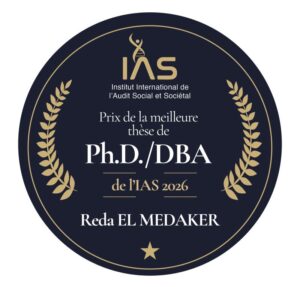 The badge awarded to the 2026 winner, Dr Reda El Medaker, for the best PhD/DBA thesis |
The jury
The Events and Prizes delegation
- Arnaud Lacan, chair of the jury
- Maria-Giuseppina Bruna
Winners
2025-2026 winners
Dr Reda El Medaker
Winner of the International Raymond Vatier Prize, awarded in Geneva.
Clara Delval
For work on how the HR function is changing in organisations increasingly driven by data. Jury chaired by Guillaume Flamand.
Submit an application
Submit your application, manuscript and explanatory note online before 31 March 2027. The form is in French.
Apply nowPage updated on 26 October 2026.